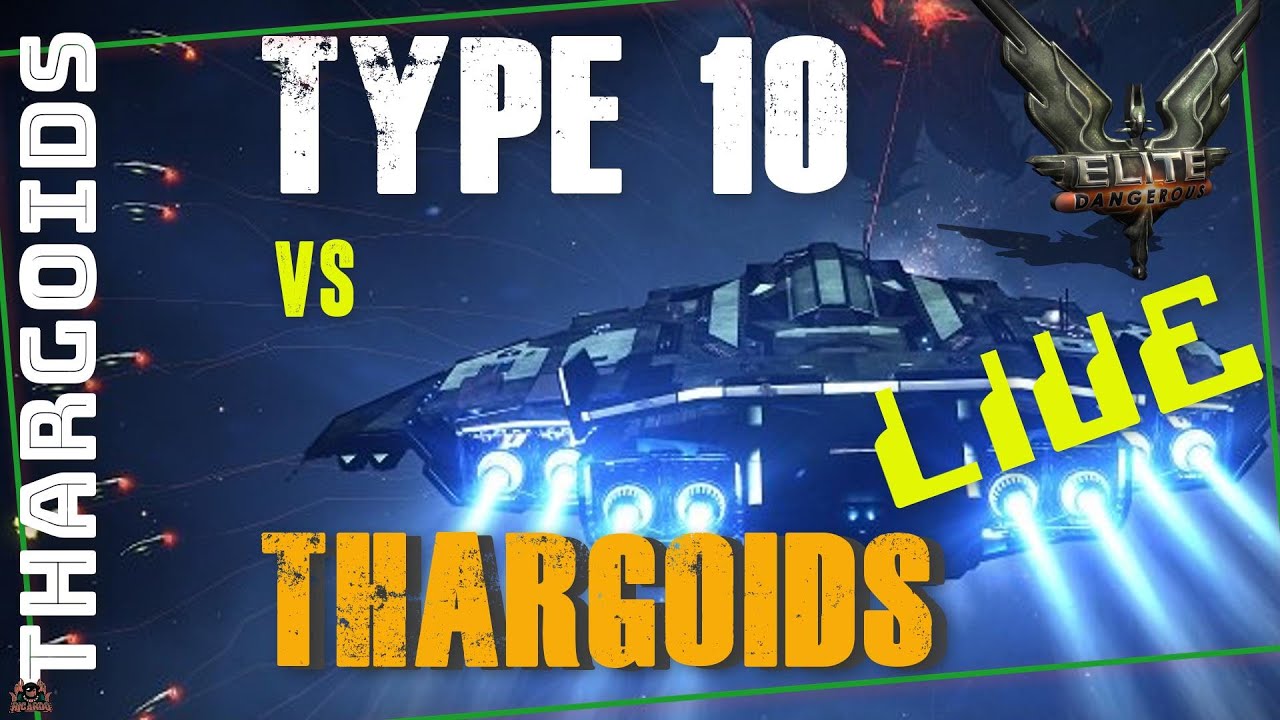

The Type-10 Defender is one of the most purpose-built anti-Thargoid ships in Elite Dangerous. Faulcon DeLacy designed it specifically to fight back against the Thargoid incursion, and while it is not the most elegant ship in the game, it is one of the most effective pure AX combat platforms available to commanders who want to contribute to the Thargoid War without spending hundreds of millions on engineered bi-weave shields and engineered hull. This guide covers how to configure the Type-10 for AX combat, what it does well, where it struggles, and how to use it effectively against Thargoid Interceptors.
Why the Type-10 for AX Combat?
The Type-10 Defender sits in an interesting position in the AX meta. It is not the fastest AX ship, nor does it have the best jump range for getting into and out of Thargoid-contested systems. What it has is an enormous number of hardpoints — eight in total — and a hull-heavy defensive profile that can absorb a significant amount of Thargoid damage before you are in serious trouble. This makes it relatively forgiving for newer AX pilots who are still learning the mechanics of Thargoid combat.
With eight hardpoints, the Type-10 can mount more AX weaponry than almost any other ship. This translates into a high sustained DPS output against Thargoid shields and hull, which compensates for the ship’s relative lack of speed and maneuverability. Against Cyclops and Basilisk Interceptors, the Type-10 can deliver enough firepower to crack the shield and destroy the heart in a reasonable time while its defensive mass keeps it alive long enough for pilots to learn the correct approach patterns.
Recommended Type-10 AX Combat Build
The standard AX loadout for the Type-10 uses a combination of AX multicannons and AX missile racks across its eight hardpoints. A typical configuration uses four large AX multicannons (fixed) on the primary hardpoints, with medium AX missile racks filling the remaining four. The AX multicannons deliver consistent damage to Thargoid shields and hull, while the missile racks deal concentrated burst damage that helps break through the regenerative shield faster.
For the utility slots, the essential items are a Shutdown Field Neutraliser, a Decontamination Limpet Controller, and Caustic Sink Launchers. The Shutdown Field Neutraliser counters the Thargoid Interceptor’s signature EMP attack — without it, your ship will be powered down for several seconds during which you are completely vulnerable. The Decontamination Limpet Controller removes caustic build-up from Thargoid weapons; without decontamination limpets, caustic damage will eat through your hull over time even after you disengage from combat. Caustic Sink Launchers absorb incoming caustic projectiles and significantly reduce the amount of caustic that stacks on your hull per fight.
Hull reinforcement packages are essential. The Type-10’s defensive strength comes from stacking multiple hull reinforcement packages in its internal slots, with thermal resistance and caustic resistance where possible. Engineering the HRPs with Heavy Duty and Deep Plating significantly increases the effective HP pool you have available in a fight. Guardian Hull Reinforcement Packages offer additional protection specifically relevant to Thargoid combat and are worth including once you have access to Guardian technology.
Fighting Thargoid Interceptors in the Type-10
Thargoid Interceptor combat in the Type-10 follows the same fundamental pattern as all AX combat, but the Type-10’s low speed and poor agility mean that certain approaches need to be adjusted. The classic cold orbit — maintaining distance from the Interceptor while orbiting cold enough to avoid being targeted — is harder to execute in a Type-10 than in a faster ship like a Krait Mk II or Chief. The Type-10 compensates with raw defensive mass: it can take more hits before needing to retreat.
The key mechanics to understand for Type-10 AX combat. First, the Interceptor’s shield must be broken before you can damage the heart. Use your AX multicannons to chip down the shield, then switch to a coordinated volley from both the multicannons and missile racks to deal concentrated damage to the exposed heart quickly before the Interceptor regenerates it. Each heart destroyed triggers a behaviour change from the Interceptor — it becomes faster and more aggressive with each heart you remove.
Second, caustic management is crucial. Every time an Interceptor attacks you with its primary weapons, it applies caustic damage that continues eating through your hull even after the attack ends. Decontamination limpets remove this build-up, and Caustic Sinks reduce how much stacks up per attack. Run limpets constantly whenever caustic is applied — do not wait until your hull is critically damaged to start decontaminating.
Third, the Shutdown Field is the Type-10’s biggest risk point. When an Interceptor executes its EMP attack (a visible warning pulse before the shutdown occurs), activate your Shutdown Field Neutraliser immediately. Failing to neutralise the shutdown in a Type-10 is particularly dangerous because the ship is slow to re-engage once systems come back online — you will have taken significant damage while powered down and may be in an unrecoverable position before you can respond.
The Type-10 vs Different Interceptor Variants
Against the Cyclops Interceptor — the entry-level variant — the Type-10 is genuinely powerful. Its eight hardpoints deliver enough firepower to break Cyclops hearts efficiently, and its defensive bulk means even less experienced pilots can survive long enough to learn the patterns. The Cyclops is the recommended practice target for pilots new to AX combat, and the Type-10 makes that learning process more forgiving than smaller, more maneuverable builds.
Against the Basilisk — the second-tier Interceptor and significantly faster than the Cyclops — the Type-10 starts to show its limitations. The Basilisk moves fast enough to outmanoeuvre the Type-10 in sustained combat, making cold orbit maintenance more difficult. Experienced pilots can still defeat Basilisks in a Type-10, but it requires more precise execution than the Cyclops fights. The Medusa and Hydra variants are generally not recommended for Type-10 engagements by solo pilots — these require either a highly engineered ship or coordinated wing combat.
Type-10 vs Thargoids: The Practical Assessment
The Type-10 Defender is an excellent ship for learning AX combat. Its defensive bulk and high hardpoint count make it more forgiving than faster, squishier builds, and its ability to mount significant AX firepower means you can contribute meaningfully to engagements even while your skills are still developing. It is not the endgame AX ship — that distinction goes to the Federal Corvette, Federal Gunship, or engineered Krait Mk II in most competitive AX meta discussions — but for players starting their AX journey or looking for a capable ship at a moderate price point, the Type-10 Defender is exactly what it claims to be.
For more Elite Dangerous AX combat guides, ship reviews, and Thargoid War content, explore the Elite Dangerous hub — everything you need to fight in the black.
📺 Watch the Type-10 vs Thargoids on Ricardo’s Gaming YouTube — subscribe for Elite Dangerous guides, AX combat, ship builds and more.
Related Guides
- Elite Dangerous Station Rescue Missions Guide: How to Save the Burning Stations
- Elite Dangerous Thargoid Spire Sites: What They Are and How to Survive Them
- Elite Dangerous Combat Guide 2026: Weapons Ships and Dogfighting Tips for Beginners
- Elite Dangerous News and Updates 2026: Everything Thats Changed in the Galaxy
More Elite Dangerous Guides
- Elite Dangerous Beginner’s Guide 2026
- Elite Dangerous Ship Guide 2026
- Elite Dangerous Combat Guide 2026
- Elite Dangerous Exploration Guide 2026
- Elite Dangerous Ship Comparisons 2026
- Elite Dangerous Trading and Economy Guide 2026
- Elite Dangerous Laser Mining Guide 2026
- Elite Dangerous Powerplay 2.0 Guide
- Elite Dangerous Panther Clipper Review
- Elite Dangerous Cobra Mk5 Review
- Elite Dangerous Type-11 Prospector Review
- Elite Dangerous Caspian Explorer Review
- Elite Dangerous Kestrel Mk2 Review
- Anaconda vs Federal Corvette
- Every Ship in Elite Dangerous Reviewed
- Elite Dangerous Space Settlement Guide — Trailblazers
- Elite Dangerous News and Updates 2026
- Best Cargo Ships in Elite Dangerous 2025
- Can You Play Elite Dangerous Like Star Wars?
- Returning Players Guide 2025
- Elite Dangerous Hub — All Guides