
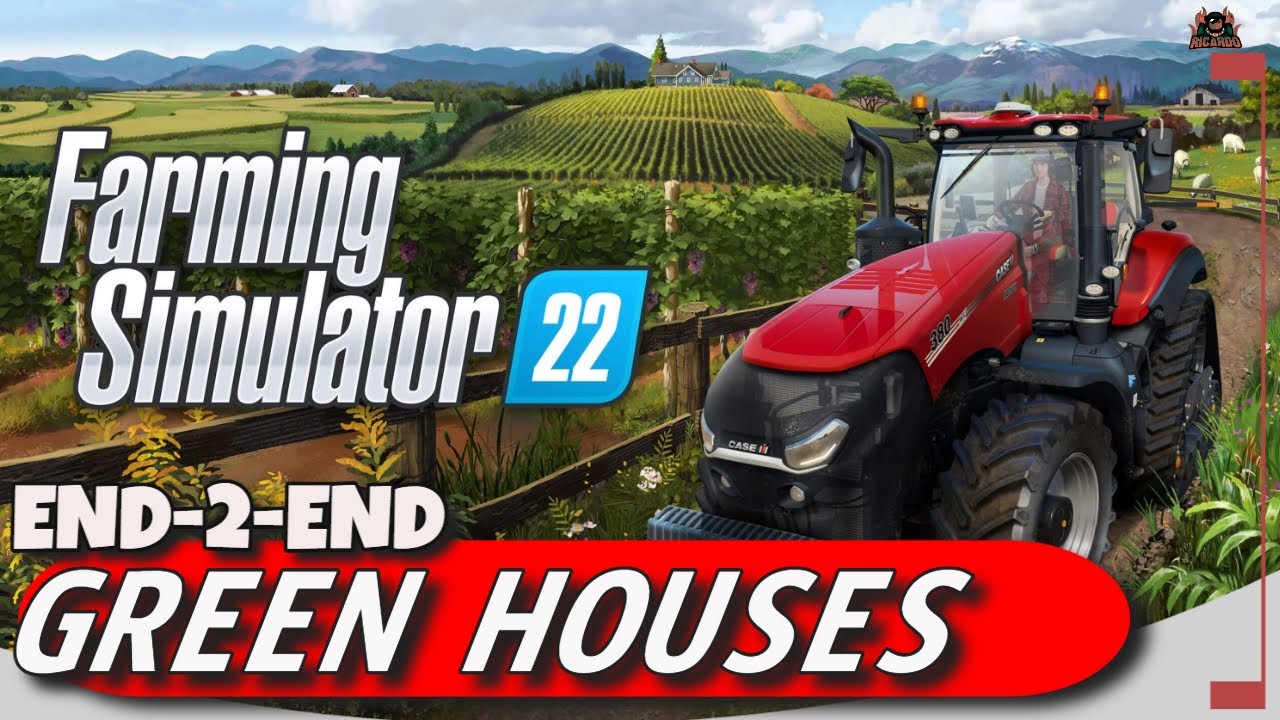

Greenhouses in Farming Simulator 22 offer one of the most reliable sources of passive income in the game. Unlike field crops that require seasonal cycles, planting, tending and harvesting, greenhouses produce output continuously throughout the year regardless of season. Once set up correctly, a greenhouse operation generates money with minimal ongoing input — making it one of the best investments for players who want consistent cash flow without constant active management. This guide covers how greenhouses work, how to maximise their output, which products are most valuable, and how to integrate greenhouse income into a broader farming operation.
How Greenhouses Work in Farming Simulator 22
Greenhouses in FS22 are placeable buildings that you purchase and place on your farm. Unlike regular crop fields, greenhouses do not require you to sow seeds in season or worry about weather and growth stages. Instead, they accept water and electricity as inputs and continuously produce specific products over time. The production cycle runs regardless of the current season, which means greenhouse income flows throughout winter when field farming is impossible and your regular crop production is at a standstill.
The key resources that greenhouses consume are water and electricity. Water can be supplied from a water tower on your farm property (purchased separately) or from a water truck run from a natural water source. Electricity can be connected from the grid or generated using solar panels or wind turbines placed on your property — and generating your own electricity significantly reduces the ongoing cost of greenhouse operation, making the net margin of the greenhouse income more attractive over time.
What Greenhouses Produce and Their Value
Different greenhouse types produce different products, and the value per production cycle varies considerably between them. The most commonly used greenhouse types in efficient FS22 operations are the vegetable greenhouse (producing various vegetables), the strawberry greenhouse, and the flower greenhouse. Each produces a different sellable product with different market values and different demand patterns from selling points around the map.
Vegetables produced by the greenhouse can be sold directly to selling points or used as inputs into more complex production chains — a vegetable greenhouse feeding into a food factory or restaurant production chain generates significantly more value per input unit than selling the raw vegetables alone. Understanding the production chains on your specific map and identifying which greenhouse output integrates most efficiently into those chains is the key to maximising the return on your greenhouse investment.
Flowers from the flower greenhouse have stable sell value and consistent demand from certain selling locations. They are not the highest-value greenhouse product, but they are simple to manage — the output can be sold directly without additional processing, making the flower greenhouse attractive for players who want passive income without the additional complexity of managing downstream production chains.
Setting Up Your First Greenhouse
Before purchasing a greenhouse, plan your placement carefully. Greenhouses need to connect to water and electricity infrastructure, so placing them near your existing farm hub where you already have water and power infrastructure reduces the cost of getting them operational. Consider also the proximity to vehicle paths — you will need to collect the output regularly, and a greenhouse placed awkwardly far from your farm’s road network becomes a logistical headache during busy farming periods.
After placing the greenhouse, set up water delivery. The simplest approach in the early game is to use a water tank truck — fill it from the nearest water source (stream, lake, or water tower), drive to the greenhouse, and connect the water supply. More advanced operations use a permanent water pipe connection from a water tower, which automates water delivery and removes the need for a manual truck run every few cycles. The water tower investment pays for itself in saved time and vehicle wear fairly quickly once you have multiple greenhouses operating.
Connect the greenhouse to an electricity source. Early on, this is typically the grid connection that comes with the greenhouse purchase — straightforward but carries an ongoing electricity cost. As your operation grows, investing in solar panels or wind turbines to generate your own electricity eliminates this cost entirely and improves the net margin of your greenhouse income. Solar panel placement is constrained to south-facing locations for maximum efficiency; wind turbines need open areas without obstruction from buildings or trees.
Maximising Greenhouse Income: Scale and Production Chains
One greenhouse produces a modest income stream. Multiple greenhouses produce a meaningful passive income. The scaling economics of greenhouse farming are straightforward — each additional greenhouse adds proportionally to your total output, and the infrastructure costs per unit decrease as your operation grows. Running five to ten greenhouses of the same type creates a level of passive income that can fund significant field farming operations, vehicle purchases, and land acquisitions without requiring constant active play.
The most profitable greenhouse strategies involve integration with production chains. Vegetables from your greenhouse feeding into a soup factory, a restaurant, or a food production building create significantly more end product value than selling the vegetables raw. If you identify a production chain that needs vegetable input and has a high output price, prioritising a vegetable greenhouse to feed that chain is one of the best return-on-investment decisions in FS22 mid-game planning.
Timing your collection runs efficiently is the other key to greenhouse income management. Greenhouse output accumulates in a storage buffer — if the buffer fills before you collect, production stops. Setting up a regular collection schedule, either manually or using hired workers with appropriate equipment, ensures your greenhouses are always producing rather than sitting idle with a full buffer. This is particularly important at peak production times when other farm tasks might occupy your attention.
Greenhouse Farming as Part of a Balanced FS22 Economy
The real value of greenhouses in FS22 is their role as a stable base income that funds your more volatile and seasonally-dependent field farming operations. Crop prices fluctuate, seasons affect what can be planted, and field farming requires constant active engagement during planting and harvest windows. Greenhouses provide the steady background income that keeps cash flow positive during the quiet periods of the field farming cycle and gives you the financial stability to invest in equipment upgrades, additional land, and more complex production chains without having to time purchases around harvest windows.
Think of your greenhouse operation as the financial foundation of your farm — not the most glamorous part of FS22, but the part that makes everything else possible. Get your greenhouses running early, scale them as your cash reserves allow, and watch the passive income pay for your next tractor while you focus on the parts of farming you enjoy most.
Find more Farming Simulator 22 guides and tips at the Farming Simulator 2022 hub.
📺 Subscribe to Ricardo’s Gaming on YouTube for Farming Simulator guides, passive income strategies, and farming game content.